
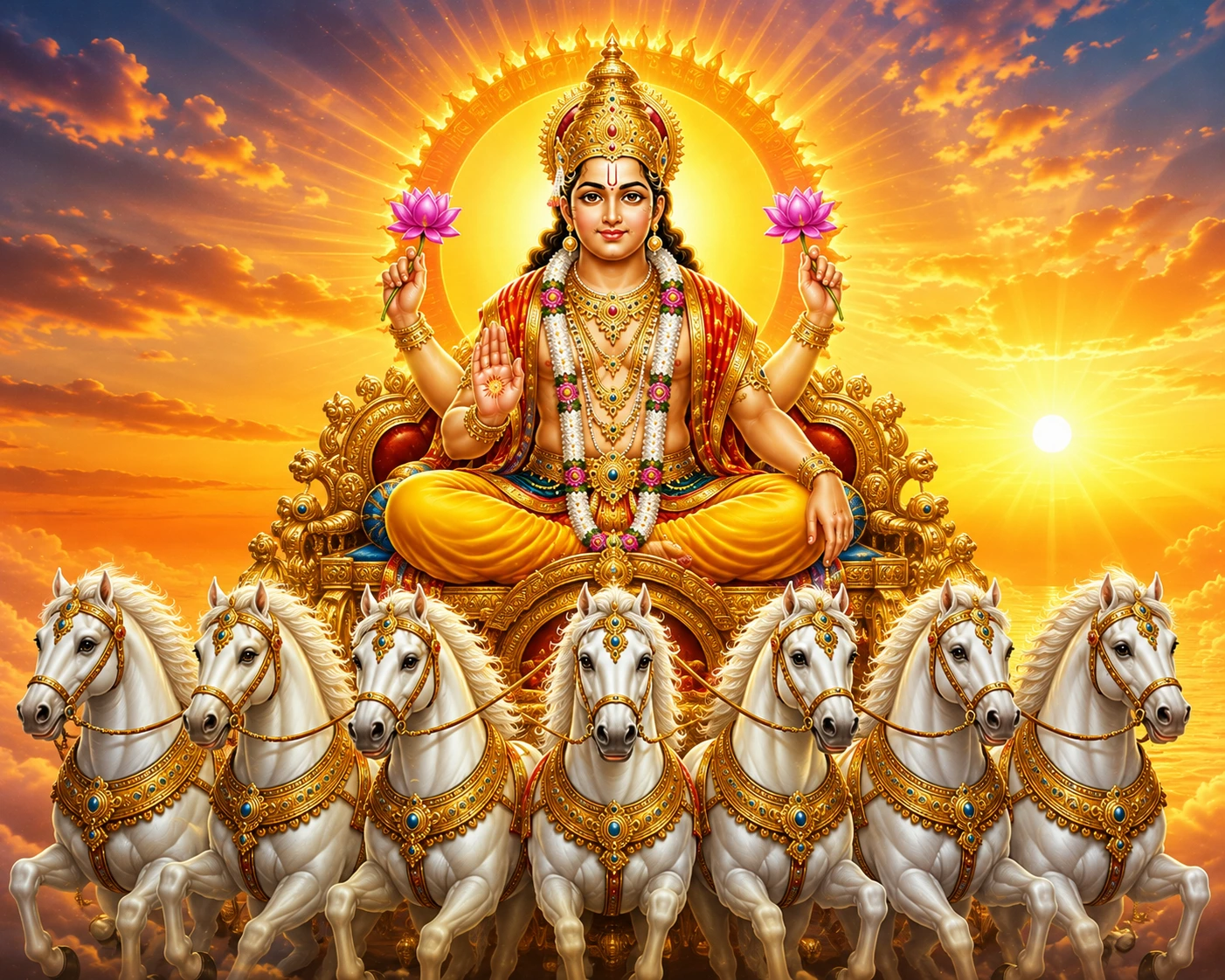
Sunday (Ravivar) Vrat Katha — Surya Dev
The Sunday fast is dedicated to Surya Dev, the Sun God, observed for health, vitality, and honour. Below is the complete story, fasting rules, and benefits.
Sunday Vrat Katha
In ancient times, there lived an elderly woman who regularly observed a fast every Sunday in devotion to Lord Surya Dev.
Every Sunday, she would wake up before sunrise, bathe, clean herself, and purify her courtyard by plastering it with cow dung. She would then worship Lord Surya Dev, listen to the Sunday vrat katha, offer bhog to the Sun God, and eat only once during the day.
By the grace of Lord Surya Dev, the old woman lived a peaceful and prosperous life without any major worries or difficulties. Her home was always filled with food, wealth, and prosperity. Seeing her happy and prosperous, her neighbour became very jealous of her.
The old woman did not have a cow of her own, so she would collect cow dung from the cow tied in her neighbour’s courtyard and use it to clean her own courtyard. The neighbour disliked this. One Saturday night, she tied her cow inside her house so that the old woman would not be able to collect its dung.
The following Sunday, the old woman could not find any cow dung. Therefore, she was unable to clean her courtyard. Since she could not clean the courtyard, she did not offer bhog to Lord Surya Dev and did not eat herself either. She went to sleep hungry and thirsty that night.
During the night, Lord Surya Dev appeared to her in a dream and asked why she had not performed her usual worship and fast that day. The old woman humbly told Him everything about her neighbour tying the cow inside the house and her inability to obtain cow dung.
Pleased with the old woman’s devotion and dedication, Lord Surya Dev said: “O Mother! I am extremely pleased with your devotion. I shall bless you with a divine cow that will fulfil your wishes and fill your home with prosperity.” After giving her this blessing, Lord Surya Dev disappeared.
The next morning, before sunrise, the old woman awoke and was astonished to see a beautiful cow and her calf standing in her courtyard. She was overjoyed and began lovingly taking care of the cow.
When the neighbour saw the beautiful cow and calf in the old woman’s courtyard, her jealousy increased even more. Suddenly, she noticed that the cow was producing golden dung. She was extremely astonished. Whenever the old woman was away, the neighbour would secretly take the golden dung to her own house and replace it with ordinary dung from her own cow.
She continued doing this for many days. The old woman remained unaware of what was happening, while the neighbour gradually became very wealthy.
Lord Surya Dev came to know about the neighbour’s deceit. One day, He caused a powerful storm. Seeing the storm, the old woman brought her cow inside the house and tied it there.
The next morning, she discovered that the cow had produced golden dung inside the house. She was amazed. From that day onward, she began keeping the cow inside the house, and the neighbour could no longer steal the golden dung.
The old woman soon became very wealthy. Seeing her prosperity, the neighbour became even more jealous. Eventually, she told the king about the old woman’s miraculous cow that produced golden dung.
The king ordered his soldiers to bring the cow and calf to the palace. The soldiers arrived at the old woman’s house and took the cow and calf away despite her repeated pleas and tears. The old woman was deeply distressed. She did not eat that day and spent the entire night praying to Lord Surya Dev to return her cow and calf.
The king was delighted to have the miraculous cow. However, the next morning, when he saw the golden dung, he was astonished.
Meanwhile, Lord Surya Dev saw His devotee suffering and took pity on her. That night, He appeared to the king in a dream and said: “O King! Return the old woman’s cow and calf to her immediately. This cow was granted to her because of her devotion and Sunday vrat. If you do not return them, calamity will befall your kingdom.”
The king became frightened by the divine command. The next morning, he respectfully returned the cow and calf to the old woman. He also apologised for his mistake and gave her wealth as compensation.
The king punished the neighbour and her husband for their wrongdoing. He then announced throughout the kingdom that everyone should observe the Sunday vrat.
The people began observing the Sunday fast with devotion. According to the tradition, the observance brought happiness and prosperity to the kingdom, people’s difficulties were removed, and peace and well-being prevailed everywhere.
Thus, it is believed that those who faithfully observe the Sunday Vrat, listen to the vrat katha, and worship Lord Surya Dev according to tradition receive His blessings and attain health, peace, prosperity, happiness, and well-being.
॥ Jai Bhagwan Surya Dev ॥
🪔 Fasting & Puja Vidhi
- Bathe before sunrise on Sunday morning.
- Offer water to Surya Dev from a copper vessel (Surya Arghya) at sunrise.
- Offer red flowers and red sandalwood, and chant the Surya Mantra. “Om Ghrini Suryaya Namah” is a commonly used Surya mantra.
- Read the vrat katha and perform the Surya Dev aarti.
- During the fast, follow your family tradition regarding fruit-based fasting or sattvic food. In some traditions, devotees eat only once and avoid salt and oil.
- At the end of the puja, pray to Lord Surya Dev for good health, peace, prosperity, and fulfilment of one’s wishes.
Benefits
- Grants health, vitality, and radiance.
- Increases honour, respect, and reputation.
- Removes troubles related to one’s father or paternal lineage.
- Brings positivity and inner strength into life.
- Devotees seek the blessings of Lord Surya Dev for longevity and overall well-being.
Frequently Asked Questions
Who is the Sunday fast dedicated to?
The Sunday fast is dedicated to Surya Dev, the Sun God, observed for health, vitality, and honour.
How is water offered to the Sun?
Fill a copper vessel with water, add red flowers and sandalwood, and offer it to Surya Dev around sunrise while praying or chanting a Surya mantra..
What should be avoided on this fast?
This depends on the vrat tradition being followed. In some traditions, devotees completely avoid salt and oil and eat only once during the day. In other traditions, fruit-based or other sattvic fasting food is followed. Therefore, it is appropriate to follow your family or regional tradition.